 English
 العربية
 China
how can we help you
You can contact us any way that is convenient for you. We are available 24/7 via email or telephone.
Contact Us



A facial cleanser sourcing brief should explain the intended washing routine and the experience customers expect during and after use. Shantou S.E.Z. Baojie Industry Co., Ltd., based in Shantou, Guangdong, China, provides personal care and home care OEM, ODM and private label manufacturing. For a private label facial wash project, a useful discussion connects the product format, sample evaluation and final dispenser.
Established in 1993, Baojie has a 70,000 square metre site and 38 production lines. Visit the official About Us page for the company introduction, then identify facial cleanser references in the Products catalogue. Ask how the proposed formula direction, container and order quantity fit the specific project; factory size and line count are background facts rather than a commitment to an individual order's capacity.
Prepare one brief for each cleanser version. Give each reference a name or code so that fragrance, texture and packaging discussions remain attached to the correct product.
Explain whether the concept is a gel, cream or foam format, and confirm suitable options with the manufacturer. Describe the appearance and dispensing experience you want rather than relying on a format name alone. If the concept uses a foam dispenser, include that packaging requirement from the beginning.
Add the intended sales channel, customer routine and label directions. For example, specify whether the proposed instructions describe application to wet hands or wet skin and how the product should be rinsed. Keep the brief focused on the intended experience. Claims about a particular skin concern need their own evidence and review.
Evaluate appearance, fragrance and handling before the washing comparison. Record how the sample comes out of its container and how easily the chosen amount spreads during use. For fragrance, distinguish the impression before application, during washing and after rinsing so feedback leads to a specific revision.
Use the same sample amount, water temperature, application time and rinsing approach for each comparison wherever practical. Changing several conditions at once makes it harder to explain why one sample feels different. Record the conditions alongside the sample code and date.
Assess foam as one observation alongside spreading, rinsing and after-use feel. Foam quantity alone is not a measure of cleansing performance or mildness. Give separate feedback on the foam experience and ask what evidence supports any proposed performance or mildness claim.
Describe after-use observations in plain terms: how the skin feels immediately after rinsing, whether a noticeable residue remains and whether the fragrance fits the brief. A preference comparison guides development; discuss the additional product checks needed before launch.
A tube and a pump bottle create different handling questions. For a tube, review the outlet, cap operation and the amount dispensed with a comfortable squeeze. For a pump, check the dose and how the dispenser behaves with the selected cleanser sample. Confirm that the formula's flow and the packaging mechanism work together.
Use the intended container for the packaging review. Check closure fit, visible leakage and cleanliness around the outlet after use. Ask which compatibility, sealing and transport checks are appropriate for the agreed package, and document any remaining questions.
Send the proposed fill size, label area and carton requirements with the packaging reference. Confirm which components the quotation includes, and review any later change of bottle, tube, closure or dispenser.
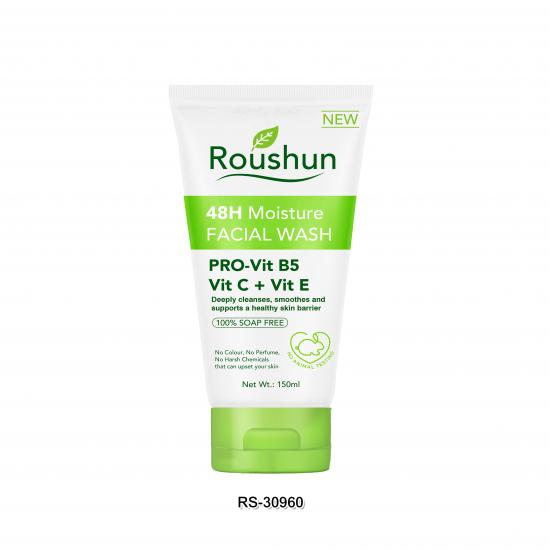
ROUSHUN facial wash tube shown in Baojie's public catalogue. Confirm formula, fill size, cap and artwork for the selected private-label project.
Baojie's own-brand MOQ is 1 carton, while the private-label MOQ is 1,000 pieces. State the quantity for each cleanser and packaging version so the starting arrangement can be discussed accurately. Clarify the selected product and carton configuration for an own-brand order.
Free samples are available, with a usual sampling period of 3–7 days, subject to the project. Confirm the sample request and shipping arrangements directly. This sampling period is separate from commercial production and delivery planning.
Keep the sample code, revision date, reviewer comments and approval decision together. If the next sample changes texture or fragrance, record that change clearly rather than reusing an earlier approval for a different version.
Identify the destination country and target market before final artwork. Discuss the label language, ingredient information, directions, warnings and responsible business details applicable to that market. Review the intended claims against the information and supporting evidence available for the selected formula.
Ask which documents can be provided for the proposed product. SDS or MSDS and COA may be relevant where applicable; confirm availability and the required document list for the specific formula and destination. Agree who will review the documentation and resolve open questions before the artwork is approved.
Send a compact brief that lets the manufacturer evaluate the product and packaging together:
Identify the cleanser format, intended washing routine and reference sample.
Describe fragrance preferences and the after-use experience to evaluate.
Provide the container reference, fill size, dispenser and label language.
State the quantity, destination country and target market.
List required documents and name the person responsible for sample approval.
After reviewing samples, consolidate the agreed product reference, package components and artwork version into one approval record. Discuss production and shipping arrangements against that agreed specification. This gives subsequent discussions a clear starting point and makes proposed changes easier to assess.
State the desired format and describe its appearance, flow, application and rinsing experience. A reference sample with written comments gives the manufacturer a more useful direction than a general request for a premium face wash.
Foam volume is one part of the washing experience. Compare it alongside spreading, rinsing and after-use feel, and discuss the evidence needed for cleansing or mildness claims. Keep these observations separate on the sample review sheet.
The own-brand MOQ is 1 carton and the private-label MOQ is 1,000 pieces. Free samples are available, with a usual sampling period of 3–7 days subject to the project. Confirm the chosen product, packaging and shipping arrangements directly.
Discuss the pack during the initial inquiry and assess the selected sample in the proposed container before approval. Review dispensing, closure fit, leakage observations and the agreed packaging checks together with the product specification.
Contact Morgan, CEO, at sezmorgan@foxmail.com or WhatsApp/Tel +86 135 0140 8869. Provide the product category, target market, estimated quantity, destination country and packaging requirements, plus any cleanser reference and sample evaluation priorities. Use the official Contact Us page to send a structured inquiry.
If you are interested in our products and want to know more details, please contact us

Factory Address : Sihuang Road, Lugang Town, Chaonan District, Shantou City, Guangdong Province, China


If you are interested in our products and want to know more details,please leave a message here,we will reply you as soon as we can.
 IPv6 network supported


